

October 4, 2026
Can financial literacy bring informal sector firms and workers into the formal economy?
Written by Dr. Jeffrey Dickinson
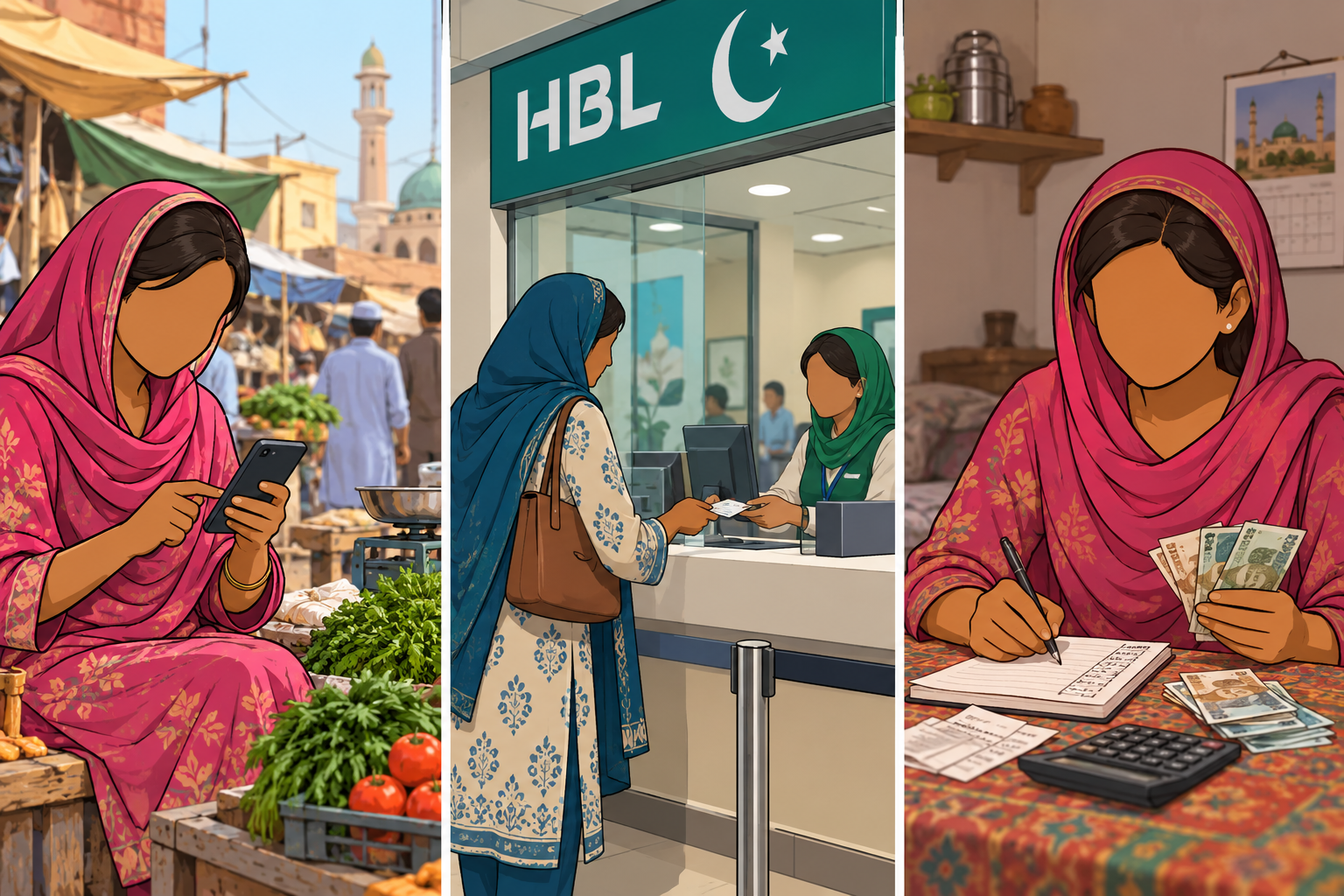
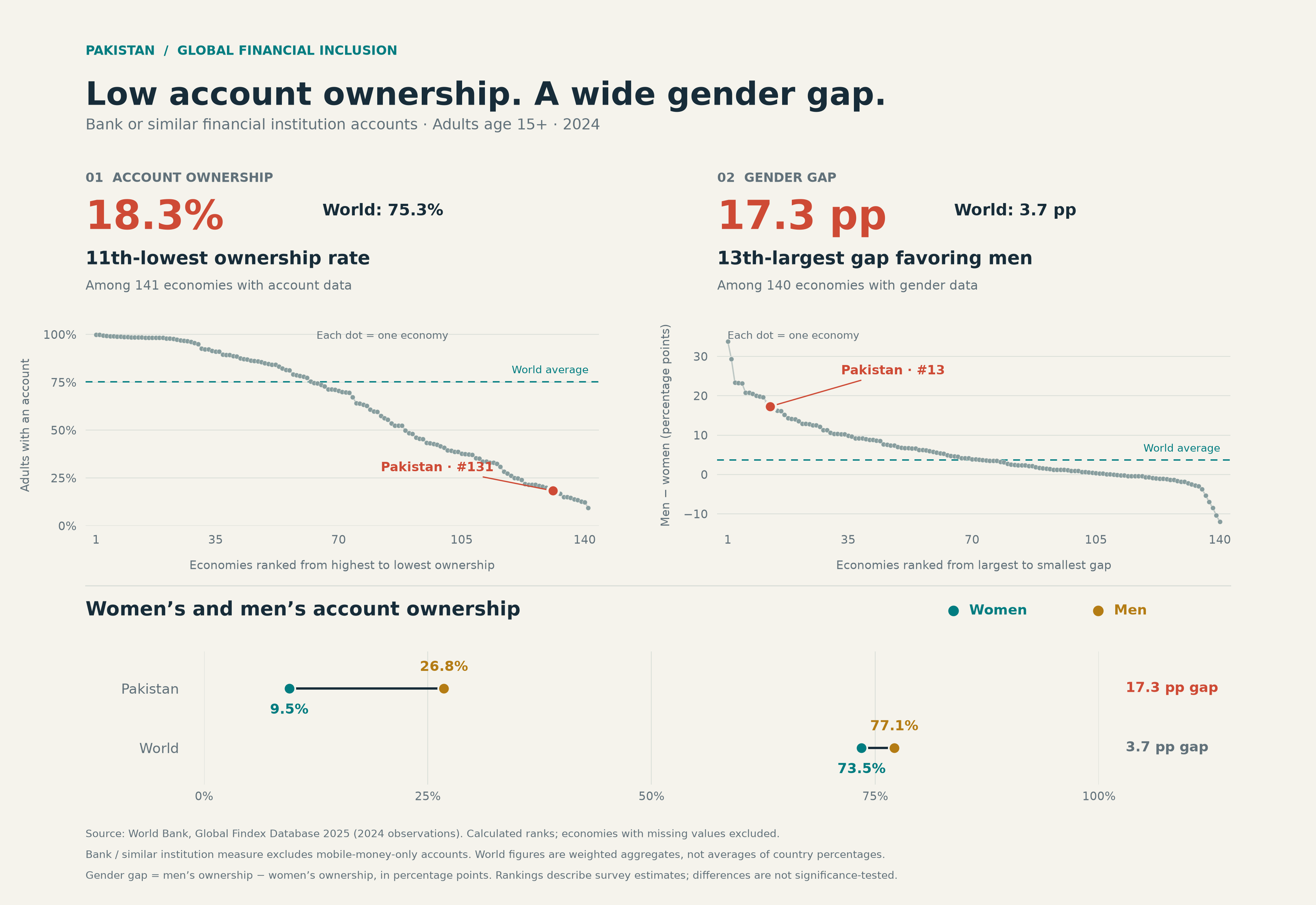
A recent report out of Pakistan about their low rates of financial literacy caught my eye. Though the report does not outline causal pathways, the authors of the report raise an interesting question: could improving financial literacy actually shift economic activity from informal to formal (Rauf and Ali 2026)? In Pakistan, financial literacy levels are especially low. Only 18% Pakistani adults have no formal bank account according to World Bank Global Findex Database 2025 data. The gender gap in bank accounts in Pakistan is also very pronounced where only 9.5% of women have formal bank acounts.
A famous paper by Dupas and Robinson (2013) shows that women significantly benefit from having savings accounts. Owning accounts help keep their money protected from outside influences and theft. Based on the research it seems clear that many women around the world would benefit from having a savings account, particularly at low or no cost.
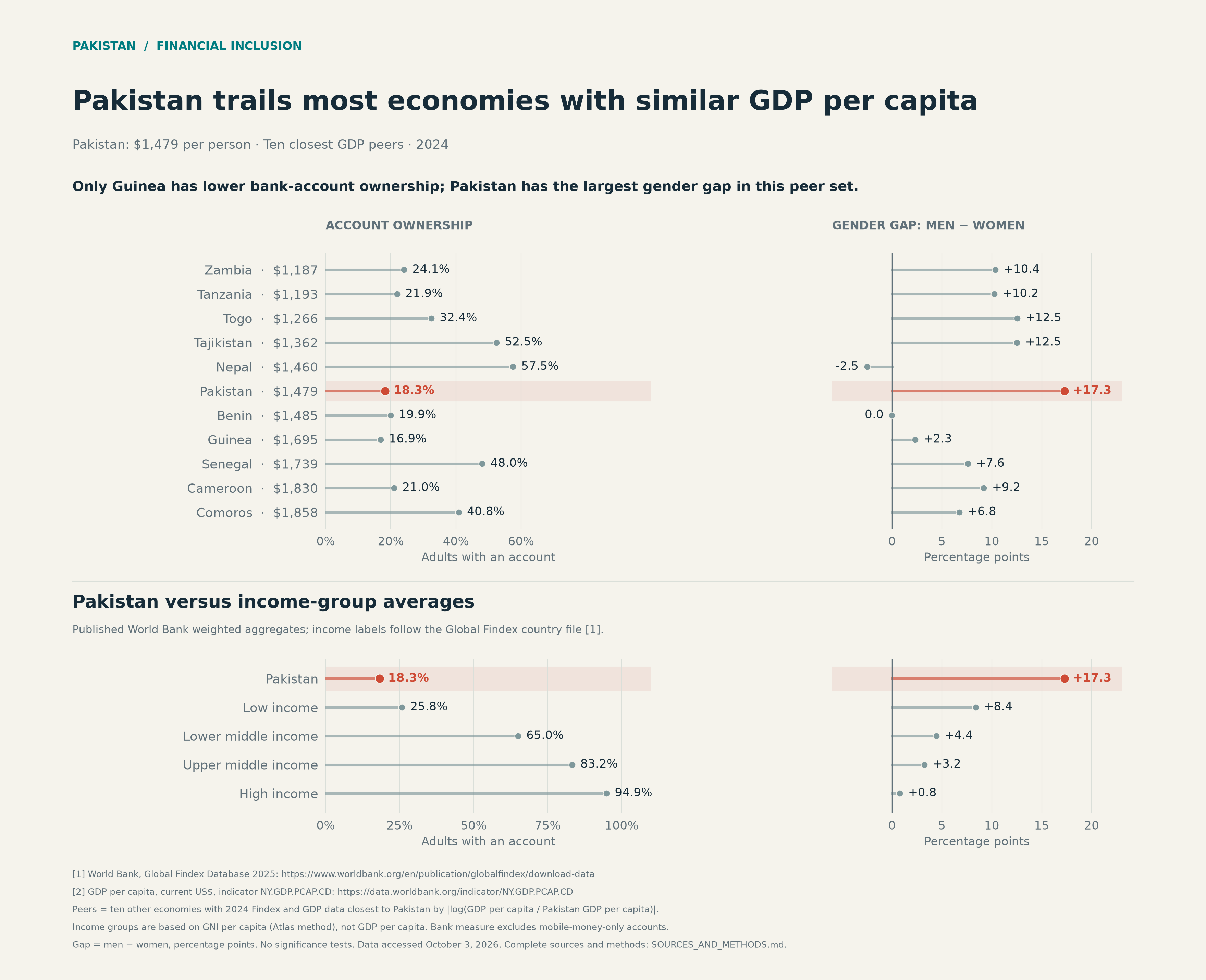
That leaves a lot of room for growth in terms of the financial knowledge of all Pakistani people, not just Pakistani women. And that is where Dollar Scholars comes in to play. Dollar Scholars lessons and website are already available in Urdu, a language spoken throughout Pakistan, and also Pakistan's official language, though there are other linguistic minorities.
But can increasing financial literacy drive firms to switch from informality to formal? Or workers to switch from being employed informally to being employed formally? Typically, education would be related to the choice of formal or informal sector job. Financial literacy specifically as a proximate factor for formal/informal job choice has not yet been tested. It is not hard to imagine, though, that greater financial literacy related to taxes could be a motivating factor for individuals or firms to move from informal to formal economic activity. A robust literature does exist on the informal sector economy. David McKenzie and others have worked hard to evaluate what might cause firms or individuals to engage in the informal economy rather than the formal one. See the references below for further reading on that topic.
Going forward, there will continue to be many questions around the informal sector. Dollar Scholars is not going away so we will keep pressing this question of the relationship between financial education and informal versus formal sector workers and firms. We plan to reach out to the authors of the report from Pakistan to collaborate and share information.
References
- Benhassine, Najy, David McKenzie, Victor Pouliquen, and Massimiliano Santini. 2018. “Does Inducing Informal Firms to Formalize Make Sense? Experimental Evidence from Benin.” Journal of Public Economics 157: 1–14. https://doi.org/10.1016/j.jpubeco.2017.11.004.
- Bruhn, Miriam. 2011. “License to Sell: The Effect of Business Registration Reform on Entrepreneurial Activity in Mexico.” The Review of Economics and Statistics 93 (1): 382–386.
- Campos, Francisco, Markus Goldstein, and David McKenzie. 2023. “How Should the Government Bring Small Firms into the Formal System? Experimental Evidence from Malawi.” Journal of Development Economics. https://doi.org/10.1016/j.jdeveco.2022.103045.
- de Mel, Suresh, David McKenzie, and Christopher Woodruff. 2013. “The Demand for, and Consequences of, Formalization among Informal Firms in Sri Lanka.” American Economic Journal: Applied Economics 5 (2): 122–150. https://doi.org/10.1257/app.5.2.122.
- Dupas, Pascaline, and Jonathan Robinson. 2013. “Savings constraints and microenterprise development: Evidence from a field experiment in Kenya.” American Economic Journal: Applied Economics 5 (1): 163–192.
- Monteiro, Joana C. M., and Juliano J. Assunção. 2012. “Coming out of the Shadows? Estimating the Impact of Bureaucracy Simplification and Tax Cut on Formality in Brazilian Microenterprises.” Journal of Development Economics 99 (1): 105–115. https://doi.org/10.1016/j.jdeveco.2011.10.002.
- Natural Earth. n.d. “Admin 0 – Countries.” Geospatial dataset, scale 1:50 million. https://www.naturalearthdata.com/downloads/50m-cultural-vectors/50m-admin-0-countries-2/.
- Rauf, Usama Abdul, and Rafia Ali. 2026. “Shrinking the Shadow Economy: How Financial Inclusion Can Shrink the Shadow Economy.” Knowledge Brief 2026: 143. Pakistan Institute of Development Economics (PIDE). https://file.pide.org.pk/pdfpideresearch/kb-143-shrinking-the-shadow-economy-how-financial-inclusion-can-shrink-the-shadow-economy.pdf.
- Rocha, Rudi, Gabriel Ulyssea, and Laísa Rachter. 2018. “Do Lower Taxes Reduce Informality? Evidence from Brazil.” Journal of Development Economics 134: 28–49. https://doi.org/10.1016/j.jdeveco.2018.04.003.
- Ulyssea, Gabriel. 2018. “Firms, Informality, and Development: Theory and Evidence from Brazil.” American Economic Review 108 (8): 2015–2047. https://doi.org/10.1257/aer.20141745.
- World Bank. 2025. “Global Findex Database 2025: Country-Level Data.” Dataset. https://www.worldbank.org/en/publication/globalfindex/download-data.
- World Bank. n.d. “World Development Indicators: GDP per Capita (Current US$).” Dataset. https://data.worldbank.org/indicator/NY.GDP.PCAP.CD.