

November 12, 2026
Money in a Circle: Access to Credit When Banks Won't Lend
Written by Natalia Iavnik
This is the first in a series of articles about ROSCAs and their popularity around the world.
A Financial System That Does Not Need a Bank
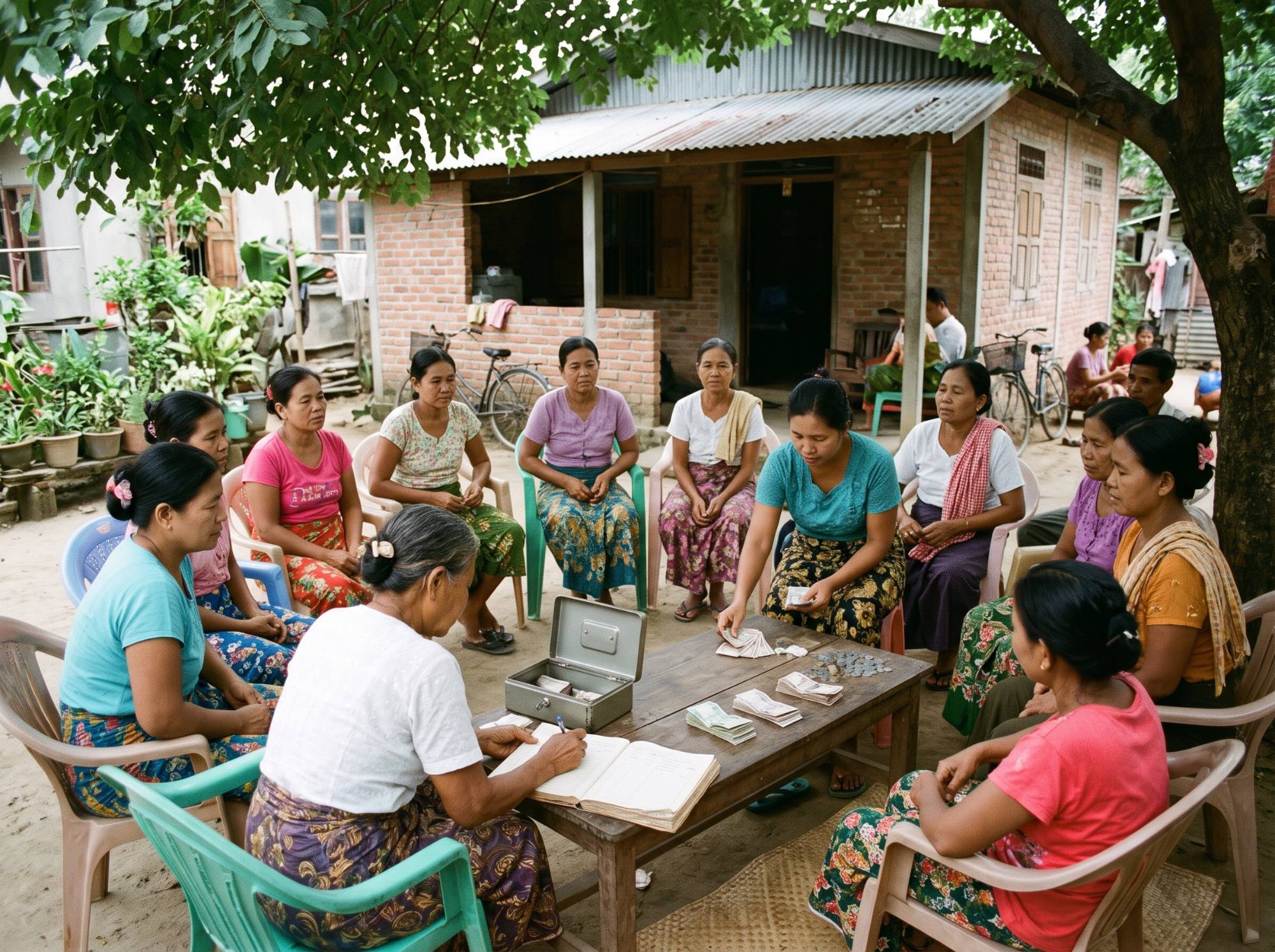
Ten people, ten equal monthly contributions. One common fund. Each month, one participant receives the money collected. This is how a ROSCA — a Rotating Savings and Credit Association — works. Participants agree in advance on the amount and frequency of their contributions, then take turns receiving the sum collected during each period. Though ROSCAs can include all different types of individuals, they are often used by women who have even more constrained access to capital.
In some systems financial access is not a given, however that does not diminish the demand for credit or liquid capital. At first glance, a ROSCA may seem like a basic arrangement among acquaintances, though its simplicity may obfuscate the fact that it fulfills a critical economic purpose, and is based on clear economic logic: a group pools future cash flows and allocates access to a lump sum over time.
Practices similar to ROSCAs exist in different countries and are known by different names around the world. Tontines are found in West Africa, stokvels in South Africa, gam'iyas in Egypt, and tandas in Mexico. Though these arrangements follow the ROSCA principle of regular, agreed contributions and the sequential distribution of a common fund, these institutions are not necessarily interchangeable as their rules, membership, and additional features and functions vary.
Why are people willing to finance one another without a bank or a conventional credit agreement? One answer concerns access to money. For someone who cannot obtain a bank loan with a low interest rate joining a ROSCA may provide a way to access capital through the group's agreed contributions. But this is neither a cost-free loan nor a universal substitute for a banking product: the benefits depend on the order in which funds are received, the reliability of participants, and the rules of the particular group.
When Saving Becomes Collective Financing
In one sense a ROSCA combines two functions: early access to financial resources for those who receive the fund sooner, and disciplined saving for those whose turn comes later. Depending on the group's rules, the order may be determined by a draw, mutual agreement, the urgency of a participant's needs, or bidding. From an economics point of view, a ROSCA is not a completely free alternative to a bank loan. The absence of an explicitly stated interest rate does not mean that there are no economic costs. The participant who receives the fund first benefits from earlier access to the money; the participant who receives it last bears the risk of inflation and the risk that other group members may default. In some types of ROSCA, this timing imbalance is offset through bidding or other allocation rules, but such mechanisms also change the economics of the arrangement.
The participants' economic positions are not identical. The woman who receives the money first gains access to the sum of money earlier than she would have accumulated it on her own. In effect, her early payout is financed by the subsequent contributions of the other participants. The woman whose turn comes last makes regular payments first and receives the pooled sum only at the end of the cycle.
Consider a hypothetical group of ten women where each contributes RUB 10,000 every month. The common fund therefore amounts to RUB 100,000. Provided that everyone contributes on time and the cycle proceeds without disruption, one participant receives the fund each month. Over ten months, each participant receives it once.
The differences become particularly clear when the time value of money is taken into account. As we know from economics, receiving RUB 100,000 today is not equivalent to receiving the same amount nine months from now. The economic outcome is affected by inflation, the potential return from alternative uses of the money, and the risk that other participants will fail to meet their obligations.
All of this underscores a critical point which is that a ROSCA does not, by itself, create additional financial resources. It reallocates access to existing and expected contributions, changing the order in which they can be used. For this reason, it is best understood as a mechanism for collective financing and mutual saving, rather than as a source of new capital.
Why Women's Participation Became a Subject of Economic Research
Economists Siwan Anderson and Jean-Marie Baland previously examined collective saving and the allocation of resources within the household using empirical data on ROSCAs.[1]
In their sample of ROSCAs in a low-income area of Nairobi, Kenya most ROSCAs consisted of women. Married women with their own income were particularly common among the participants. The article describes this mechanism as an opportunity to “protect her savings against claims by her husband for immediate consumption.”
The researchers proposed an explanation related to the distribution of financial resources within the family: participation in a ROSCA could help a woman retain control over her savings and protect them from demands that the money be spent immediately on household consumption.
This study also touches on a broader economic questions that are a significant topic in the economic development literature: intrahousehold resource allocation. Traditional household models can treat the family as a single economic unit that makes coordinated decisions about income and expenditure. More and more research from development economists and others show that in reality, spouses' interests may differ. They may have different priorities, planning horizons, and degrees of control over the money they earn.
In such circumstances, a ROSCA may serve an additional purpose: not only helping participants save, but also supporting individual control over part of their income. The findings of Anderson and Baland should not, however, be interpreted as proof that family disagreements are a universal reason why women participate in ROSCAs. The study identifies a mechanism observed in a particular Nairobi sample. Its prevalence in other countries and social groups requires separate investigation.
ROSCAs are a recurring topic in developing countries and so we will be publishing a series of blog posts on ROSCAs and how they provide a channel for women to access otherwise unreachable financial assets.
References
- Anderson, S., Baland, J.-M. (2002). The Economics of ROSCAs and Intrahousehold Resource Allocation. The Quarterly Journal of Economics, 117(3), 963–995.
https://doi.org/10.1162/003355302760193931